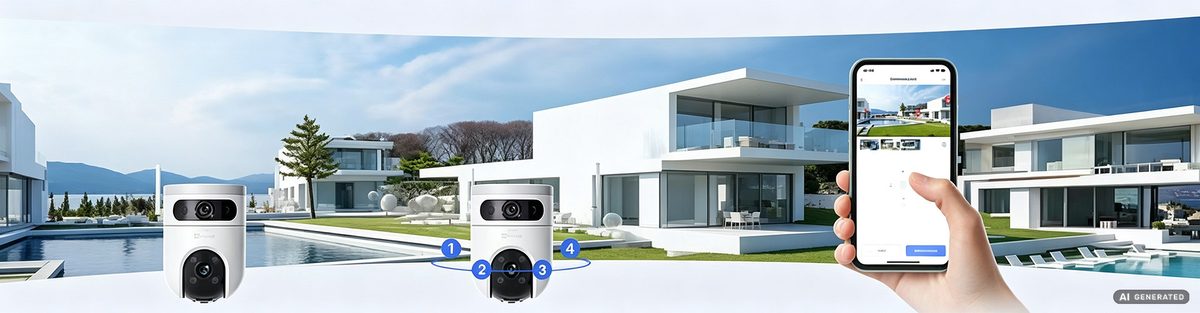
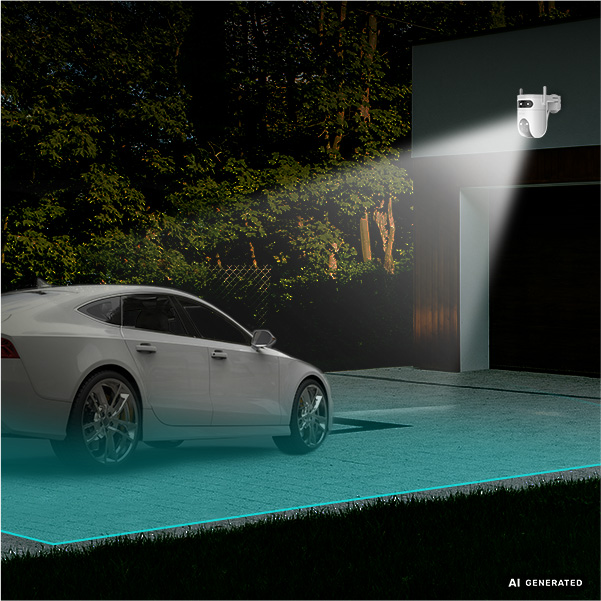
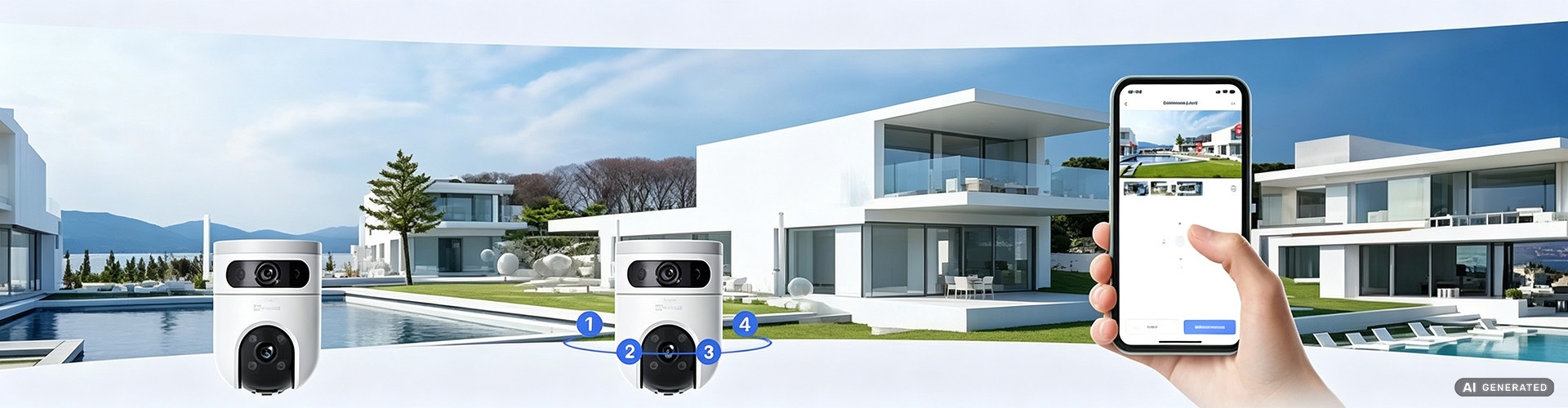
A visible security camera sends an immediate message: the property is being monitored and activity may be recorded. Models equipped with strobe lights, sirens, or voice alerts take that warning a step further by responding when a person is detected. A more discreet camera, by contrast, makes it less obvious where the camera is pointing and may be less likely to attract attention.
The right choice depends on your security goal, installation location, and risk level. No security camera can guarantee that an intrusion will never occur, but a well-planned installation can strengthen deterrence, improve early detection, and make it easier to verify what is happening around your property.
Visible vs. Discreet Security Cameras: What Are the Main Differences?
Before comparing the two approaches, it is important to distinguish between visibility—whether a camera is designed to stand out or blend more naturally into its surroundings—and the camera mechanism, such as fixed-angle or pan-and-tilt operation. A highly visible camera can be either motorized or fixed, while a compact camera can be installed in a less visually prominent way. The table below compares the two main outdoor security strategies:
Aspect
Deterrence Strategy (Visible with Light and Siren)
Monitoring Strategy (Compact or Discreet)
Primary goal
Warn and deter before an intrusion occurs
Monitor secondary areas and preserve useful footage
Response to events
May activate a strobe light, siren, or voice warning
Records the event and sends an alert to your phone
Ideal location
Main entrance, front gate, garage, or driveway
Side passages, backyards, and secondary entrances
Visibility around the property
High: clearly signals that the property is monitored
Lower: blends more naturally under eaves or against exterior walls
Role in the security system
First line of outdoor deterrence
Secondary layer for backup monitoring and verification
Which Type Usually Works Better to Deter an Intrusion?
When the goal is to discourage an attempted entry, visibility usually offers a clear advantage. Someone approaching a gate or front door can immediately see that their movements may be monitored. If the camera also turns on a spotlight or triggers an audible warning, it provides an additional signal that the security system is active.
A camera with active deterrence can be particularly useful around:
• The main pedestrian entrance.
• A driveway or garage entrance.
• Open front yards.
• Access points exposed to public areas.
However, a camera should not be installed simply to make it visible. It should be positioned to capture the actual path people take when approaching the property, minimize glare or strong backlighting, and maintain a reliable network connection. A highly visible camera pointed toward an irrelevant area may create an initial deterrent, but it will be far less useful if it cannot capture clear footage.
What Is the Most Effective Approach? Layered Security
Instead of treating “visible or discreet” as an either-or decision, it is often more effective to organize your property into different layers of protection:
1. First layer: perimeter deterrence Install a visible camera at the primary access point, such as a front door or gate. A camera equipped with lighting and a siren can provide a clear deterrent before someone approaches a vulnerable entrance.
2. Second layer: movement tracking For large driveways, garages, or gardens, a Pan & Tilt camera can follow movement across a wider area and cover sections that a fixed-angle lens may not capture.
3. Third layer: backup recording A compact fixed camera positioned in a side passage or near a secondary entrance provides a consistent viewing angle. If someone moves outside the main camera’s field of view, the secondary camera can provide additional footage.
[EXPERT TIP] Combining a panoramic camera with active deterrence at the front of the property and a fixed camera along a side passage can help reduce blind spots while maintaining a strong visible deterrent at the primary entrance.
What Type of Security Camera Works Best for Each Area?
For front entrances, garages, and driveways: active deterrence and wide-area coverage
For primary access points, a highly visible camera with active response features can be particularly useful. The EZVIZ H8c provides wide-area panoramic coverage with pan-and-tilt operation, AI-powered human shape detection, auto-tracking, and active defense using a siren and strobe light. Recordings can be stored on a microSD card of up to 512 GB or through EZVIZ CloudPlay (cloud storage availability and subscription requirements vary by market).
For wide areas or multiple access points: dual-lens technology
If you need to monitor two viewing angles at the same time, the EZVIZ H9c Dual 2K uses two lenses to provide broader coverage. Its upper wide-angle lens maintains an overview of the area, while the lower motorized Pan & Tilt lens can rotate and follow detected activity, helping capture both the wider scene and important details.
For side passages or secondary entrances: a compact fixed camera
In narrow passages where the viewing angle should remain consistent, the EZVIZ H3c is a fixed Wi-Fi camera with 1080p resolution, AI-powered human shape detection, infrared night vision, and an IP67 weatherproof design. Its compact form makes it well suited to secondary monitoring points.
For areas without nearby power outlets or reliable fixed Wi-Fi
If Wi-Fi is available but there is no convenient power outlet nearby, the battery-powered EZVIZ HB8 Lite provides flexible wire-free installation and can work with compatible EZVIZ Type-C solar panels, which are sold separately, for convenient solar charging. For more remote locations where power infrastructure or reliable fixed broadband may not be available, such as construction sites, rural properties, or detached areas, the EZVIZ HB90x Dual 4G Kit supports cellular connectivity and is available in kits that include an 8W solar panel for more flexible off-grid monitoring.
What Matters More Than Camera Size?
• Approach angle: Position the camera so it detects people while they approach the property rather than only after they are directly beneath it.
• Mounting height: Installing a camera too low makes it easier to tamper with, while mounting it excessively high may produce steep overhead views that make useful details harder to capture.
• Lighting management: Use smart lighting modes when available so spotlights activate only when relevant activity is detected at night.
• Detection zone configuration: Keep alert zones focused on your property to help reduce unnecessary notifications caused by activity in public areas.
• Connectivity testing: Check Wi-Fi signal strength at the intended outdoor installation point before drilling or permanently mounting the camera.
Which Camera Type Fits Each Security Scenario?
Home Security Need
Suitable Option
You want visible deterrence at the main entrance or gate
Wi-Fi is available outdoors, but there is no nearby power outlet
Battery-powered Wi-Fi camera (HB8 Lite + compatible optional solar panel)
You need flexible monitoring for a remote or off-grid property
4G-capable camera kit, available with an 8W solar panel (HB90x Dual 4G Kit)
What Are the Most Common Outdoor Security Camera Installation Mistakes?
• Hiding the front camera too much: If it is concealed behind plants, beams, or other structures, its initial deterrent value may be reduced. • Relying only on audible alerts: A security camera should be one part of a broader protection strategy that may also include suitable lighting and physical security measures. • Pointing the entire field of view toward a public area: This may increase unnecessary alerts while reducing coverage of the private area you actually need to monitor. • Ignoring backup viewing angles: A single device can leave side passages or secondary access points without adequate coverage.
Conclusion: Visible Cameras for Deterrence, Discreet Cameras for Added Coverage
If your main objective is to discourage unwanted approaches to doors, gates, or driveways, a visible outdoor security camera with active defense features can provide a stronger visual deterrent. For secondary areas or narrow passages, a compact fixed camera can provide consistent monitoring without dominating the exterior appearance of the property.
Combining both approaches in a layered security strategy helps balance visible deterrence with reliable backup monitoring, creating more complete coverage around the property.
Packed into a remarkably slim, durable design with sustained peak performance, long-lasting battery life, and the latest Galaxy AI, the Galaxy Tab S12 series empowers ...
The SmartTag 3 gets smaller, lasts longer, and adds a few useful tricks for tracking pets and belongings. Samsung‘s SmartTag trackers have largely stayed inside ...
Choosing the right camera for your front entrance, driveway, garage, or backyard requires careful planning. Before drilling holes or selecting a model, it is worth ...